Illustration

Twelve (3): The Observer, 1988: Axel Scheffler and Benoit Jacques

Qs

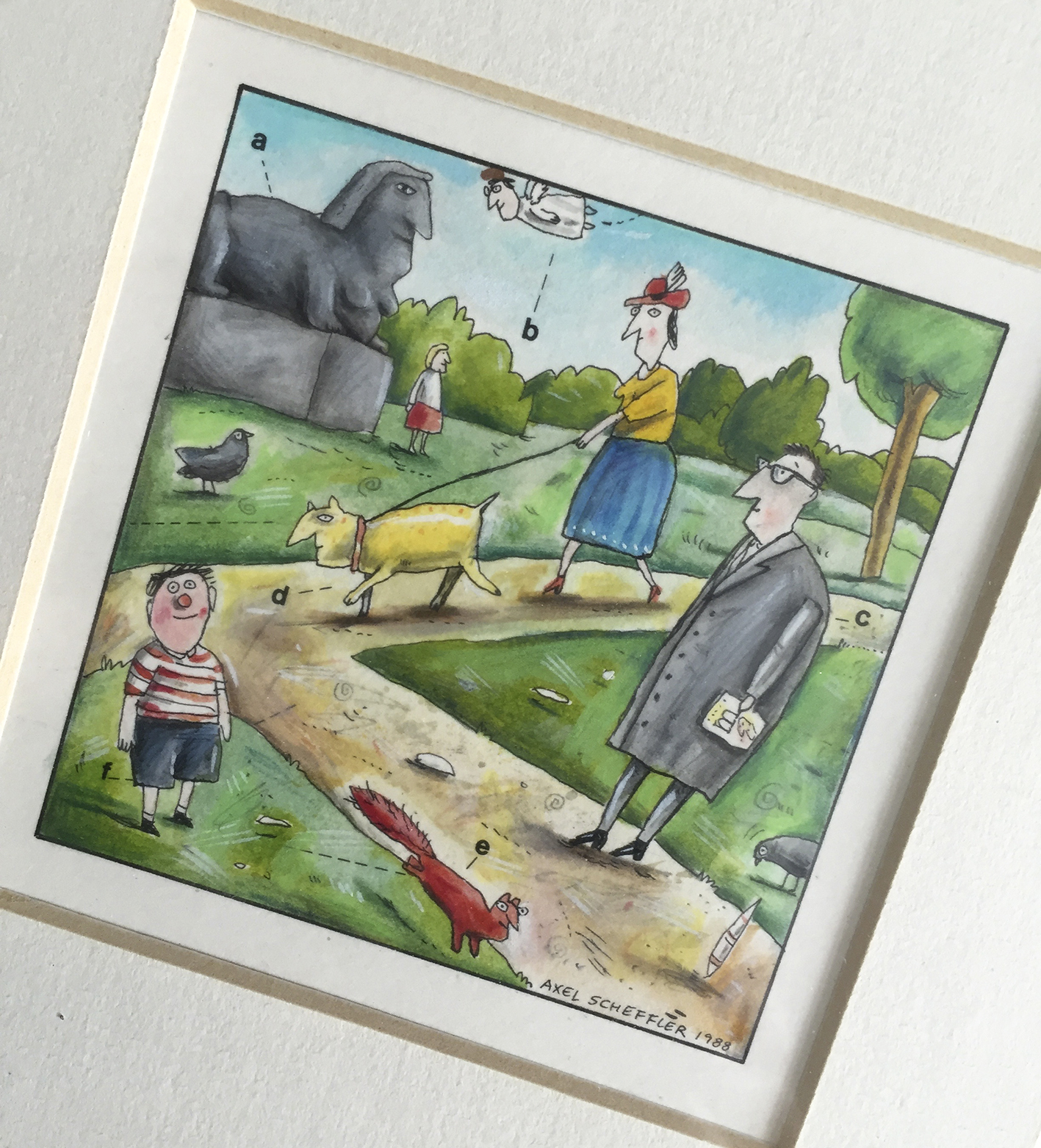
Axel Scheffler

Axel Scheffler

1 I left art college in 1985, so I was about three years into my career as an illustrator in 1988. I already had one or two pieces published as a student (maybe one commissioned by you – I can’t remember) when I started. I took my portfolio round to magazines, advertising agencies and children’s book publishers in 1986 and got some commissions straight away. And I’ve had a steady influx of jobs ever since – no ups and downs, really.

2 I felt my college education didn’t do much for me – except it gave me the idea that illustration was a proper job, and gave me the chance to draw for three years. I remember Liz Pyle (on your list as well) asking me why I was at art college (where she taught at the time) and didn’t go straight into the business…

3 It seems to have been a bit of a ‘golden age’ for illustration, so I feel lucky to have started in the late eighties (though I look at some of my work of that period and can’t understand why anybody would have paid me to do this).

4 The work is essentially the same and Cartoonist and Illustrators are still around though they seem to be used less than in that period. But I have largely moved away from editorial to children’s book illustration and don’t know much about the current market, except it’s all digitalised now.

5 My biggest project over the last 30 years has been my collaboration with Julia Donaldson on The Gruffalo and many other picture books.

All things Axel can be found here, in a rather beautiful website. I may have commissioned Axel at The Listener, but I definitely did at The Observer. Even then his brilliance at capturing character was obvious.


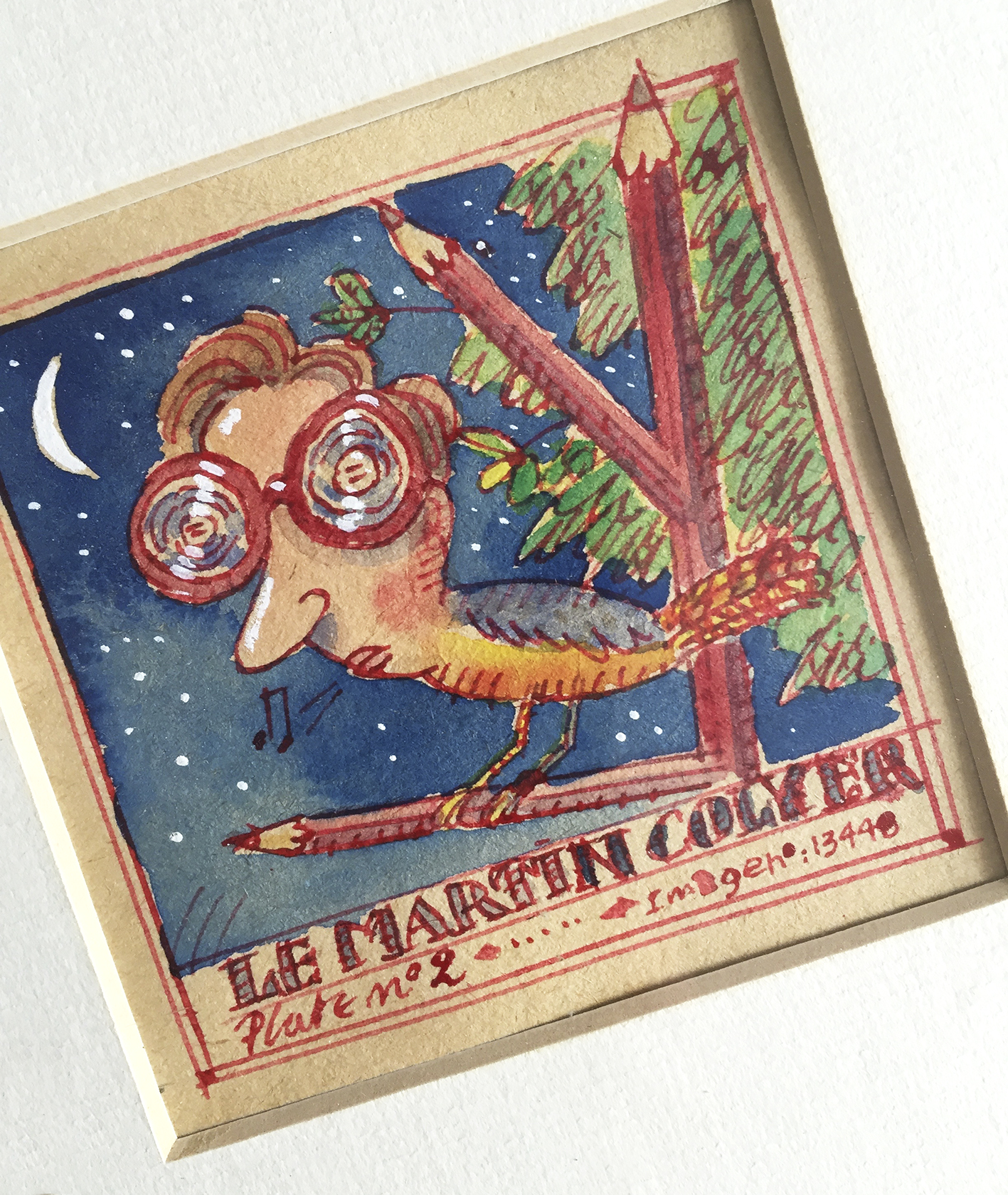
Benoit Jacques
Benoit Jacques

1 I did two years in an art college in Brussels (never finished the four years “graphic communication” course there), arrived in London in 1979, worked two years at Pentagram Design, went to New York, worked a month for R.O. Blechman, got caught two years by the social service in Belgium, went back to London in 1983, worked as a freelance graphic designer for Wolff Olins, Michael Peters & others, but because I always had enjoyed drawing, I decided in 1985, when my first son was born, to become a full-time illustrator.

2 There were loads of magazines & newspapers around, with a true tradition of using illustration and photography. The art directors were usually open-minded, unconstipated and prepared to give a chance to young inexperienced artists such as myself. I got to really know the town by going around on my pushbike with a huge black portfolio on my back, either to show my work or to deliver the goods. By 1988s, as an illustrator, I suppose I had slowly become a reliable professional. I gradually felt I was being admitted in the circle of recognised illustrators, with no idea how vain and fragile this notion was. I used to hang around with Jeff Fisher, Jean-Cristian Knaff & Richard Parent, all foreigners like myself. There seemed to be an everlasting supply of well-paid work (another vain & fragile notion). I can say I truly loved my life in those days, fascinated by the British culture, in love with London, and fully aware of my own luck. I moved to France the following decade.

3 Because of my involvement in my own publishing venture, I slowly lost touch with the context of illustration for the press in England the following years. The only reminder of that period was the weekly drawing that The Guardian kept commissioning until two years ago. When it was stopped overnight, with no real explanation or farewell note from anyone, I thought that things had decidedly changed radically.

4 It seems I could never handle prestigious jobs. In the 80’s I did a poster for the Underground (“Fly the tube to Heathrow”). The image is strange, overcomplicated and totally inefficient. In that period, I was commissioned by Swatch to do a “Paris” watch. Putting the Eiffel tower on it was part of the client’s brief. The result is horrible, and I am well ashamed of it.

5 The work I would possibly feel the proudest and happy about is my self-published book, Play it by ear. The first edition came out in 1989, thirty years ago. It is still available and keeps selling well.

Like Axel, for Benoit magazine illustration was just one string to a large bow. Books, puzzles and comics all flow freely from his fertile mind, as you can see if you visit his website.

Standard
Illustration

Twelve (2): The Observer, 1988: Liz Pyle and Carolyn Gowdy

Qs

Liz Pyle

Liz Pyle

1 By 1988 I had already spent about ten years working in the UK and New York mainly for newspapers, magazines and book publishers.

I arrived in the UK in 1978, having done an illustration degree at Philadelphia College of Art. My illustration teacher there, Al Gold, who also taught the Quay Brothers, thought I should follow in their footsteps and head for The Royal College of Art illustration course. So I took his advice and after a few months of backpacking settled in London and started the course. At the same time, I started doing the rounds with my portfolio to the newspapers and magazines first and then to a smattering of book publishers. I managed to get a couple of jobs a month, which kept me afloat through college. Afterwards, I headed to New York and spent a year freelancing there. Then back to the UK until 1988 when my husband and I headed to New York where I carried on doing editorial features and book covers on both sides of the Atlantic for about six years and then came back again to the UK.

2 I started art school as a sculpture major then switched to illustration because I wanted to do more drawing. I didn’t really fit into the commercial illustration mould and soon found myself at odds with the course. I finished though by winning the Illustration prize in my year somehow by doing something rather unconventional. This side of me was embraced by the Royal College of Art, which in 1978 was busy pushing the boundaries of what was considered illustration. I rode high on the crest of that wave of ‘radical’ illustration until it subsided.

3 This wave was also being supported by an enlightened group of art directors who also were enjoying free reign at their various publishing houses and were able to provide a platform for the illustrators. So naturally, it was a happy union of more ‘radical’ illustrators and art directors.

4 Everything changed with the internet and the availability of stock imagery. It seemed that the pendulum swung towards using photography instead of illustration.

5 I particularly loved doing the book covers for Penguin, Picador, Pandora, etc. Particularly ‘On the Black Hill’ by Bruce Chatwin, the Penguin covers for Camus and Kafka. Also, Longmans asked me to illustrate the ‘Blind Watchmaker’ by Richard Dawkins, I made 13 black and white monoprints for the chapter headings and the cover. New Scientist magazine covers were another particular favourite as they gave me a chance to do science-related themes. Then I moved into children’s’ books, which was the last oasis for illustrators.

[Optional!] I had a whale of a time making pictures for fascinating projects.

Find Liz’s stunning work, and more about her career, here.


Carolyn Gowdy

Carolyn Gowdy

1 In 1988, I was in the flow with editorial commissions, feeling inspired, positive about the direction my work was taking, and open to all possibilities to make a difference in the world as an artist. It was exciting to receive these opportunities to do work I enjoyed, to share it out there in the world, and to paid for this. I treated commissions with the same focused commitment and intensity that I did my own personal work. I was also teaching illustration part-time at the BFA level in various art colleges.

2 As an illustration student, I benefited from being given time and space to explore, experiment, and follow my intuition.

3 I completely enjoyed the opportunity that going around with my portfolio gave me to meet and interact with people.

4 Yes, the world of publishing has changed and moved increasingly from the printed page to the computer screen. I think they call it a digital revolution?

5 My favourite commission was an advertising campaign. It was thrilling to see my illustrations displayed as a series of enormous posters across the entire London Underground for at least an entire year. These same images were also featured as full-page advertisements in numerous magazines, Sunday supplements, and on postcards.

[Optional!] My art has been a vocation and a way of life. I don’t draw a line between art and illustration. Work is play and play is work.

For Carolyn, image-making is truly a vocation. If she was unsatisfied by a piece of work, she would re-do it, even if it meant coming back into the magazine office at night and “stealing’ it back! You can see some of her beguiling work here.

Standard
Illustration

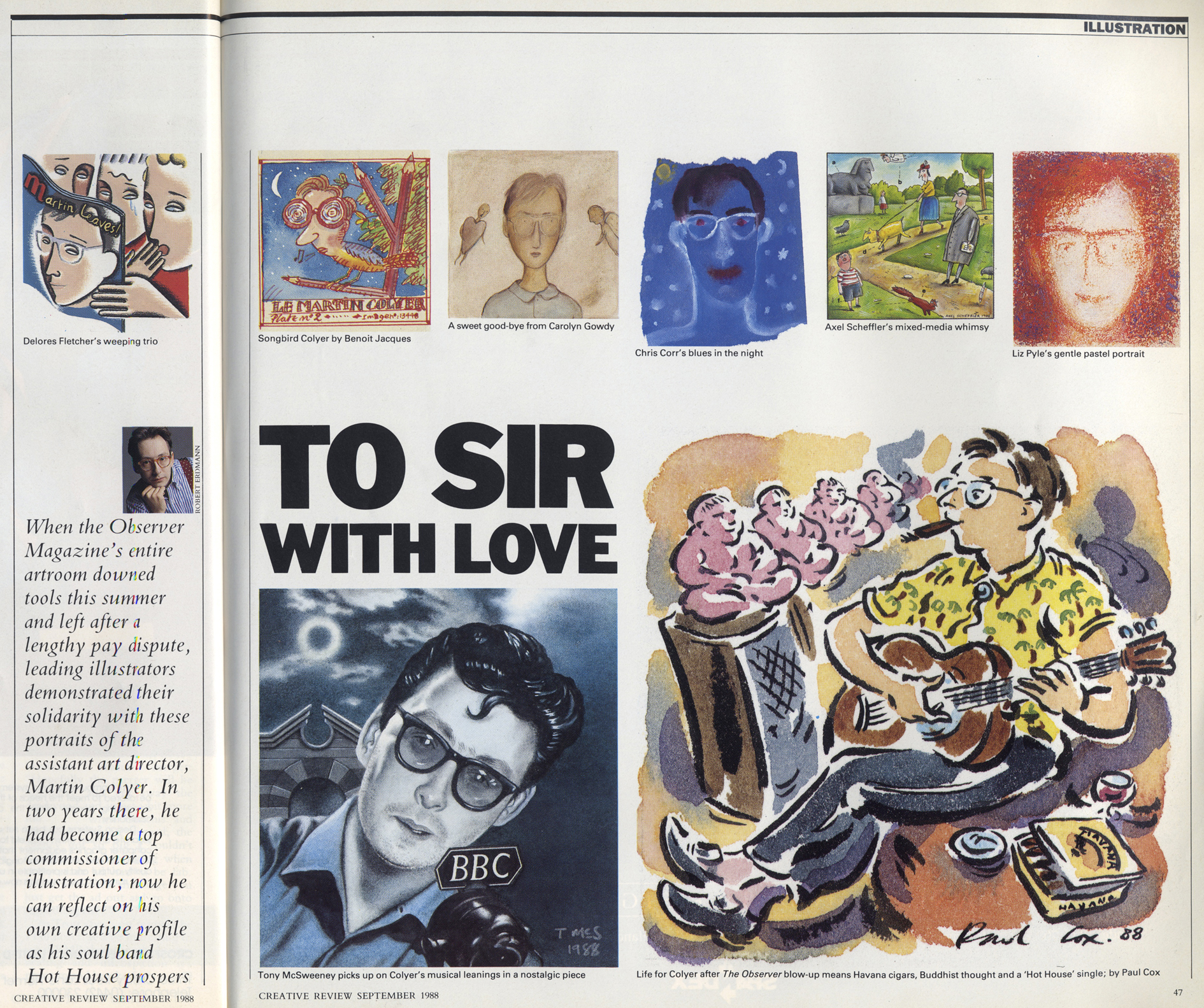
Twelve (1): On leaving The Observer, 1988

In 1988 I had just moved from Art Editing The Listener Magazine, a BBC publication with a strong tradition of using illustration as a means of dealing with often complex political and social subjects, to the Observer Magazine, the Sunday supplement of the Observer newspaper. I was Assistant Art Director, with responsibility for illustration. It was a new team at the magazine, put together by the AD, John Tennant. John had recently joined the magazine from being Michael Rand’s right-hand man at the Sunday Times Magazine, and he wanted to inject vitality and freshness to make it more than just an also-ran to the market-leader.

In the couple of years that followed we took a bold approach – we illustrated a whole feature on Ronald Reagan’s extraordinary “Star Wars” initiative, using Peter Brookes, Ian Pollock, Huntley / Muir and Jeff Fisher among others. We commissioned Brad Holland and Matt Groening (in his pre-Simpson days) and asked fashion illustrator Mats Gustafson to draw a portrait of Gore Vidal. We had fun.

We hit on the idea that our regular columns should be a showcase: Sue Arnold’s funny and spiky column (think Lucy Mangan or David Mitchell) would be illustrated by one artist in four-week slots – that would give 12 people throughout the year a month-long commission and a chance to have a themed set of work. For this slot, we used illustrators who were just getting established.

For our other weekly column, on wine, we decided that it would be great to use the talent emerging from art schools across Britain, giving 52 first-time job opportunities a year. We didn’t want to be prescriptive for either commission – we specified the finished size and left it at that. Of course, this resulted in some confusion. Still in art school-mode, some illustrators gave us four finished illustrations to choose from, as if it were a project with a crit at the end; artwork painted on bottles of wine; oil paintings that had to be reduced by 400%; collages of daunting complexity for the 50mm by 70mm space…

It was a fantastic time that came to an end when the entire art department resigned over the decision to back-date a pay cut for our freelance designers – they’d worked in good faith for an agreed fee. With the insouciance and arrogance of youth, we all figured we’d get another job without too much trouble. My colleague Shem Law (now Deputy Editor and Art Director of Radio Times) discreetly phoned a cross-section of the illustrators who had worked for us and asked them to paint portraits of me for a leaving card.

CR

The resulting work provided a glimpse into the world of illustration as it was at that time. Creative Review ran a selection of the drawings and carried the story [the references to music in some of the responses was because I had an alternative career going on at the same time…] While thinking of potential features for an issue of Varoom! on the theme of nostalgia, I thought of that leaving card and wondered what those involved could remember of that period in their lives, and how their careers had subsequently developed, so I tracked down their emails and asked if they’d answer a series of questions.

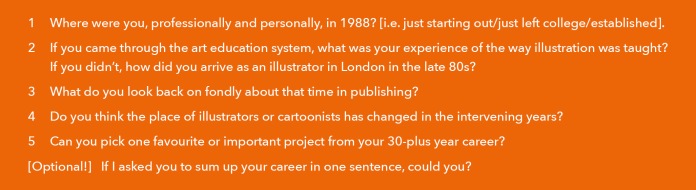
1) Where were you, professionally and personally, in 1988? [i.e. just starting out/just left college/established].

2) If you came through the art education system, what was your experience of the way illustration was taught? If you didn’t, how did you arrive as an illustrator in London in the late 80s?

3) What do you look back on fondly about that time in publishing?

4) Do you think the place of illustrators or cartoonists has changed in the intervening years?

5) Can you pick one favourite or important project from your 30-plus year career?

[Optional!] If I asked you to sum up your career in one sentence, could you?

Over the coming weeks, I’ll post what those who answered told me about life in London, publishing, and illustration in the long-gone days of ’88.

Standard